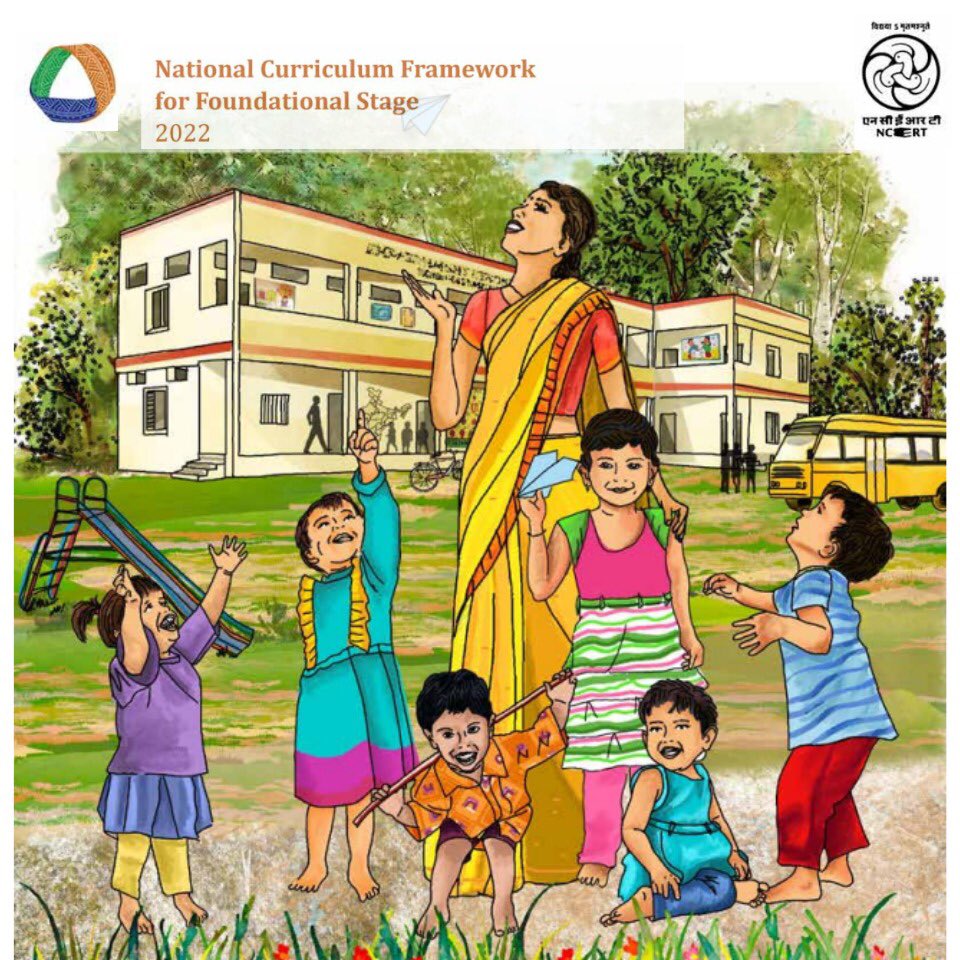
“First ever integrated Curricular Framework for children from Ages 3 to 8 in the country. In the new 5+3+3+4 structure, a strong base of Early Childhood Care and Education (ECCE) from age 3 is included, which is aimed at promoting better overall learning, development, and well-being.
Unique featues:
- Five years of flexible, multilevel, play and activity-based learning for children from Ages 3 to 8
- Based on cutting-edge research from across the world.
- Rooted in India’s deep traditions and knowledge
- Guide for Teachers and Other Practitioners.
- Enables holistic development ( Panchkosh- Annamaya kosh, prana maya kosh, manomaya kosh, vijnan maya kosh, anand maya) of all our children across institutions – Schools, Anganwadis, Balvatikas, and Preschools.
Process of Developing the NCF
- Extensive consultations across the country.
- Extensive consultations across the country
- Views from over 1.3 lakh teachers and institutions
- Inputs from over 10 lakh interested citizens
Fundamental Principles of the NCF
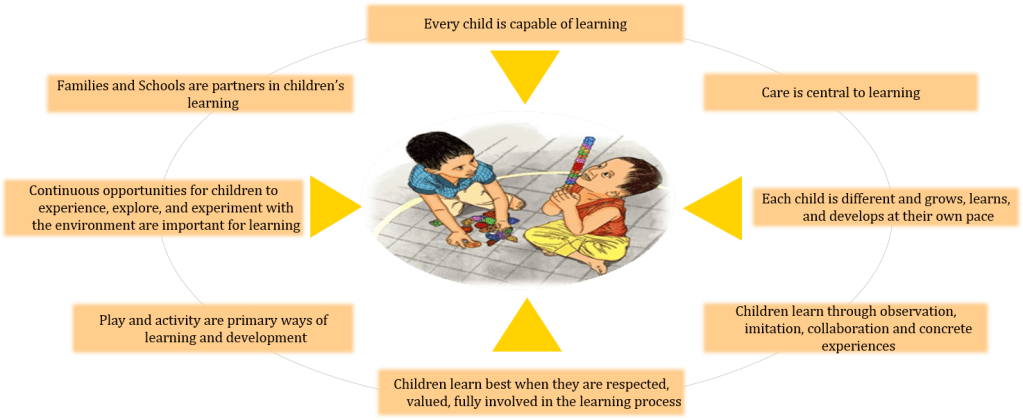
Early Childhood Care and Education (ECCE)
ECCE is defined as the care and education of children from birth to eight years & is the focus of this NCF


Curricular goals
Thirteen curricular goals are broadly classified into 6 domains:
- Physical Development.
- Socio-emotional and Ethical Development
- Cognitive Development
- language and literacy development.
- Aesthetic and cultural development
- Positive learning attitude
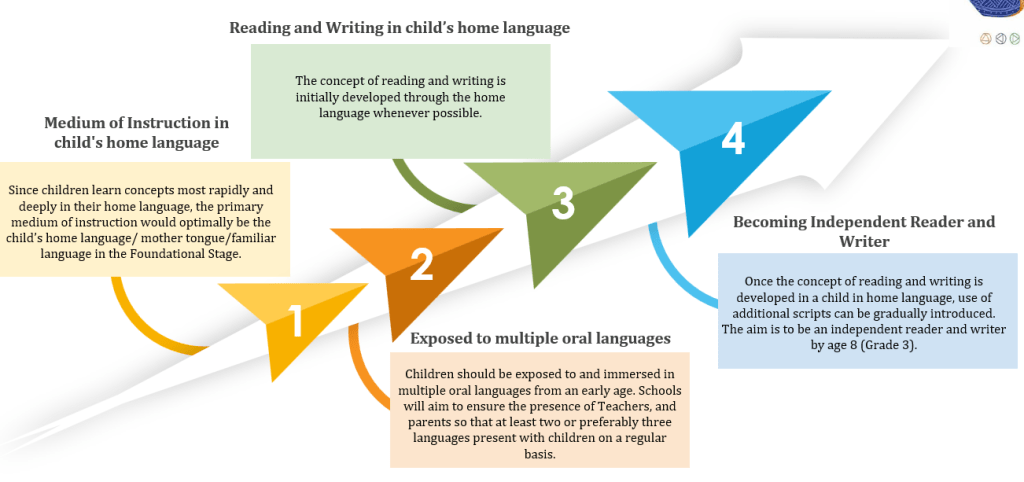
Approach to language education and learning
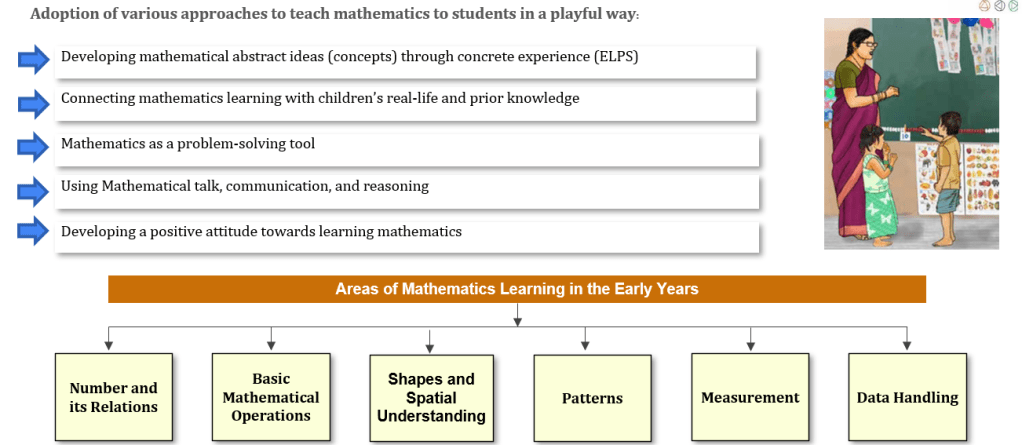
Approach to numeracy
Organizing content and learning material.
- Sensorially engaging – encourages children to examine and explore using all their senses
- Drawn largely from the context of the child
- Cater to different needs and levels of children
- Emphasis on local material, made by Teachers and children
- Print-rich environment with range of reading material – stories, poems, picture books
- All grade 1 and 2 textbooks – language and maths – will have environmental awareness integrated in them
Ways of Organising Content

Assessment for Furthering Learning
Purpose:
Identify the needs, preferences, and interests of the child to identify developmental challenges or learning difficulties the child might be facing
Give the Teacher an insight into the learning achievement of the child
Methods and tools for assessment:
- Systematic observation for assessment: Teachers can use tools such as anecdotal records, checklists, and event sampling to record their observation
- Method 2: Analysing artefacts : Compilation of artwork and activity sheets, collection of artefacts from field trips.
Documenting & Communicating Assessments
Teacher Narrative Summary: Anecdotal records, event samples, checklists, portfolios, worksheets
Holistic Progress Cards: Assessments done by the Teacher, observations by parents & self-assessments by children
Pedagogy:
Planning for teaching:
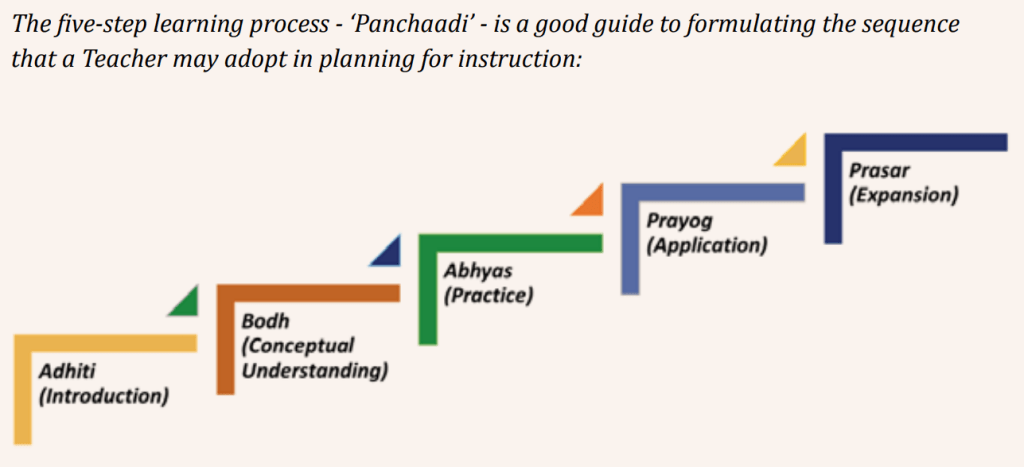
A teacher may involve Panchaadi- A five-step planning for instruction.
BUILDING POSITIVE RELATIONSHIP
Children blossom when there is a Positive relationship between Teacher, Family, and Communities
LEARNING THROUGH PLAY
Children enjoy learning through several ways –
talking, listening, using toys, painting and drawing, singing, dancing, running and jumping.
STRATEGY FOR LITERACY & NUMERACY
Four Block approach of teaching for Literacy Instruction and Mathematics
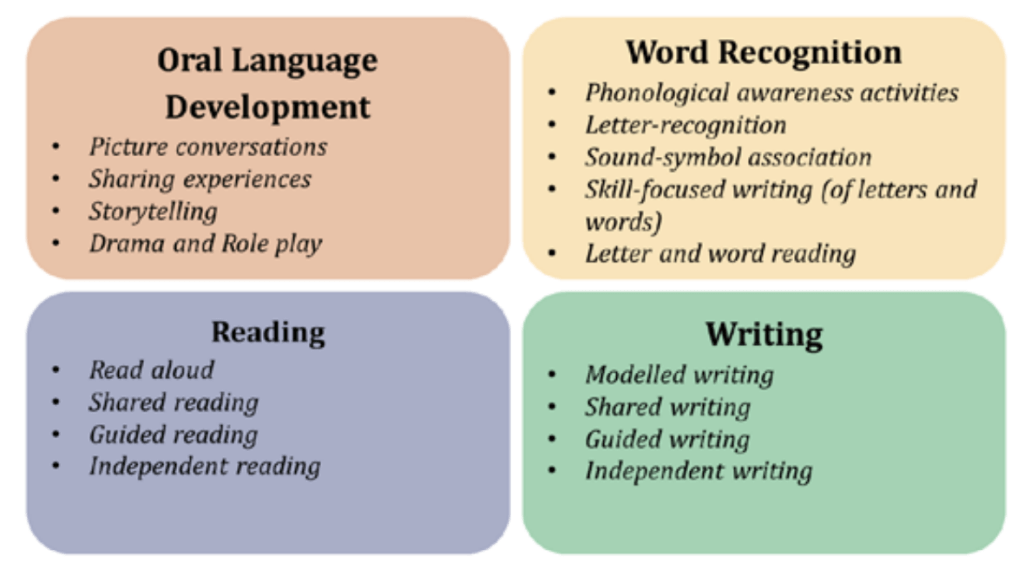
Four blocks for teaching language
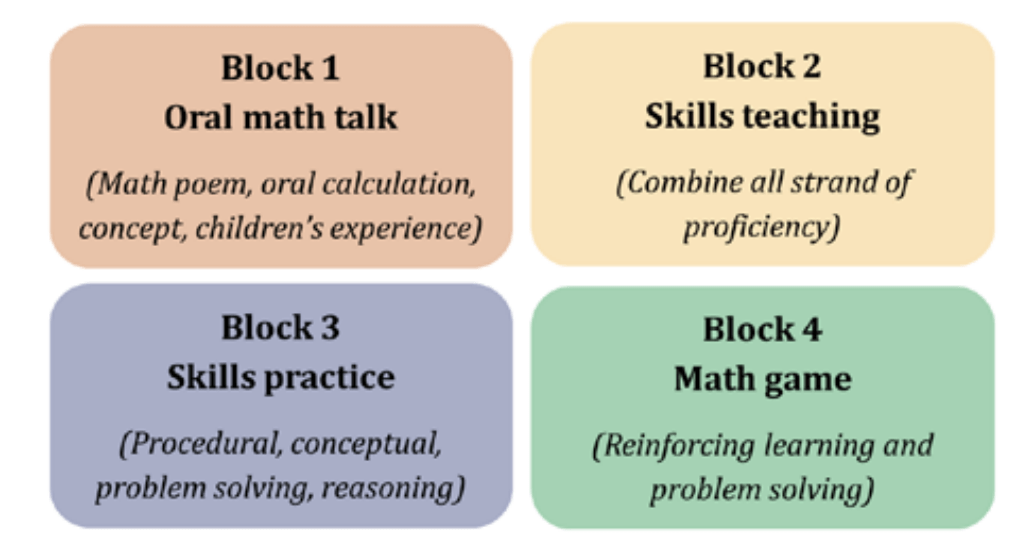
Four blocks for teaching Mathematics
ELPS approach: Experience, Language, Pictures and Symbols
CREATING POSITIVE CLASSROOM CULTURE
Creating classroom norms with children around Self- Discipline and Classroom behaviour
 BIOGEN2019